At the moment, footways in Oxfordshire fall into the cracks between different county teams. Parking, Road Agreements, Transport Development Control, Active Travel, Maintenance, and different Localities teams all implement or oversee schemes that affect footways, but no one has overall responsibility for them. A single county team should be given responsibility for footways, with a watching brief over all schemes that affect them. That could be a beefed up Active Travel team, or a Parking team with an expanded mandate. more
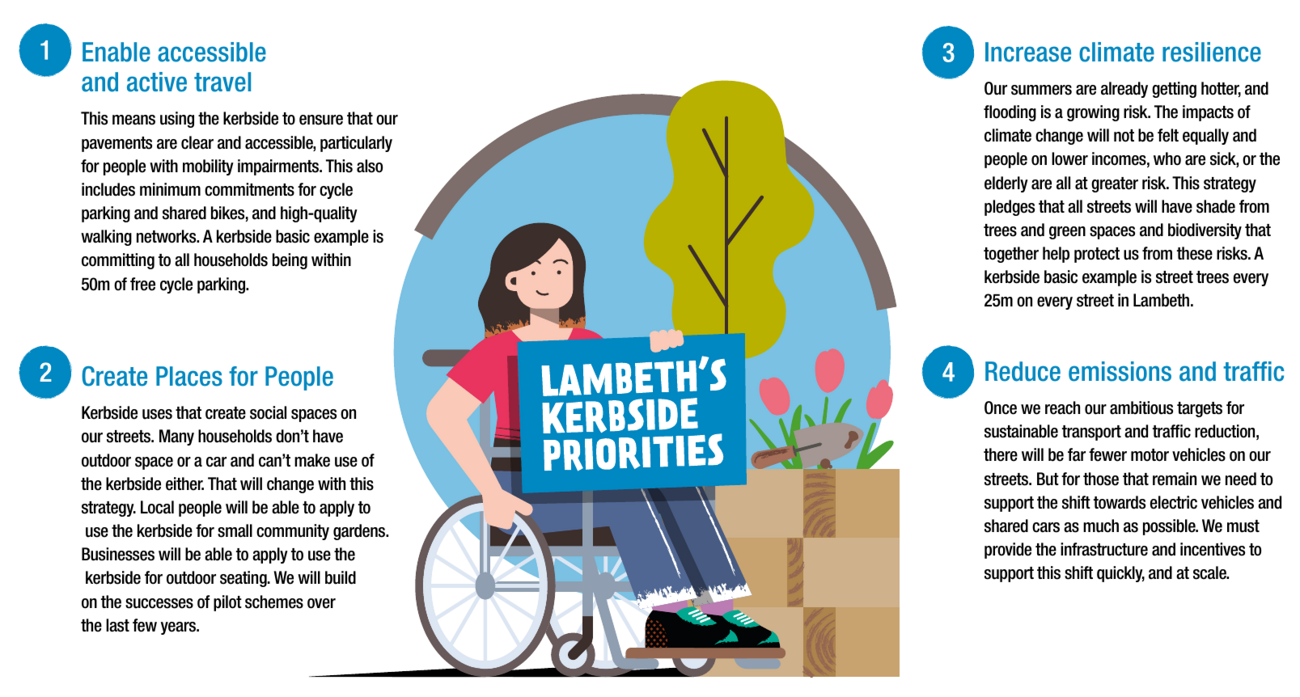
Lambeth recently released its Kerbside Strategy. This proposes a reallocation of kerbside space towards active travel, place making, climate resilience, and traffic reduction (94% of Lambeth's kerbside is currently devoted to parking or parking restrictions).
more
The key goal of Vision Zero is "to eliminate all traffic-related deaths and severe injuries, while increasing safety, health, and mobility for all". Vision Zero was originally a Swedish idea, but it has been adopted by the Netherlands and by cities such as London, Oslo, Seattle and Denver — and now by Oxfordshire, along with some other local authorities and regions. more
Parking enforcement in Oxford is woefully poor and seems impossible to improve. This creates dangers for people walking and cycling and can impede motor traffic (especially buses). Higher penalties would provide greater deterrent to the most problematic offences, without requiring additional enforcement resources. more
I think the biggest gain from controlled parking zones is the prevention of dangerous parking. This can be illustrated by the case of Boundary Brook, in the proposed Donnington CPZ Zone of East Oxford. Vehicles parked here block routes, prevent visibility, and pose a serious risk to the children at Larkrise primary school, as well as to residents and to people who use the area as a walking or cycling route.There are four year olds who cycle to school here with their parents; there are nine year olds who walk here unaccompanied. more
Oxford for Cars is a new organisation set up to further the use of cars and other motor vehicles in Oxford. Oxford for Cars opposes any attempts to restrict or control the use of cars, and demands the removal of the barriers to them that exist across Oxford.
People like to drive. The existence of obstacles to driving wherever people want to is unacceptable, and cars should be prioritised instead of having space taken away from them for clunky buses and wobbly cyclists and trundling pedestrians. more
The area we're in has recently been made a controlled parking zone, meaning that only vehicles with an area permit can park in it. Residents have to pay £60/year for a permit, with a maximum of two per house, and get a set of one-day vouchers for use by visitors or tradespeople. more